Fraud is an Operational Problem, Not Just a Tech One.
May 11, 2026
Fraud is an Operational Problem, Not Just a Tech One.
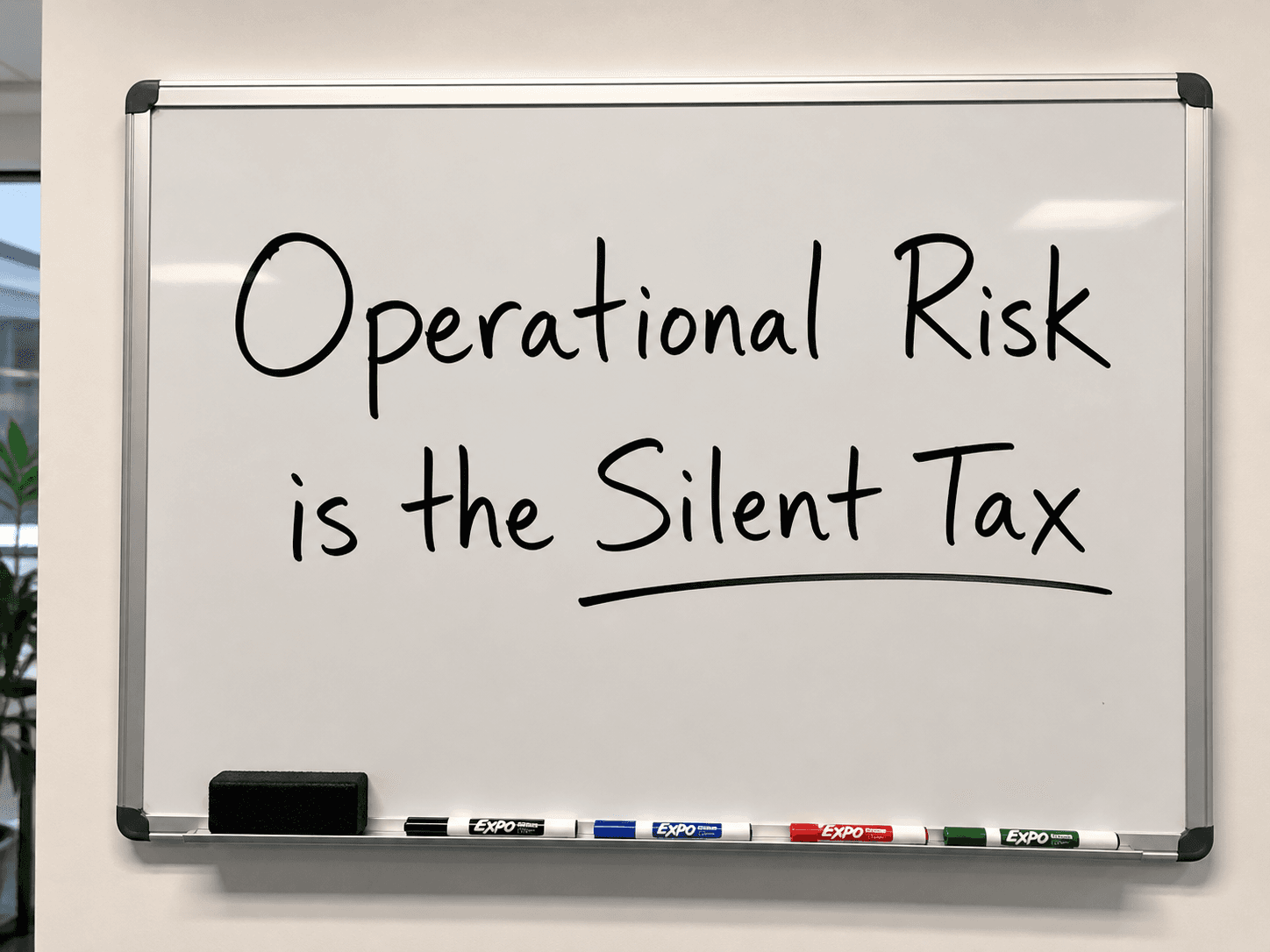
A few months ago, I read an article that mentioned operational risk as a silent tax. I can’t recall exactly where I read it, but I immediately wrote that phrase on my office whiteboard to spark my thinking on what it actually means to the work I do every day.
In every organization, and especially in the high-stakes world of automotive finance, there is an incredible amount of time talking about margins, floorplan interest, and front-end revenue. Strategy gets the airtime, innovation gets the funding, and efficiency gets measured. But there’s a persistent drag on performance that rarely gets called out, mostly because it doesn't show up cleanly on a P&L. Operational risk is that silent tax, and whether it’s acknowledge or not, it’s being paid for every day.
It lives in the gaps between your people, your processes, and your technology. It’s the manual workaround for a complex subprime lead that was supposed to be temporary but somehow became business as usual. It’s the compliance control that exists in a policy manual but isn't actually being executed on the dealership floor. It’s having the right credit or identity data but not at the moment you actually need it to structure the deal, or worse, the data signal is ignored simply to get the customer into the vehicle and out the “door” faster. None of these things feel urgent on their own, which is exactly why they stick around until they compound into something much bigger than the sum of their individual parts.
In auto finance, this tax doesn’t usually present as a single, obvious failure; it shows up more subtly through loan/lease applications in transit that stretch from three days to ten, a dealership portfolio that slowly begins to underperform because the underwriting was built for speed rather than accuracy, or fraud losses that are misclassified as credit defaults because the operational checks failed to flag a synthetic identity at the point of sale. Growth comes in slower than expected, losses creep higher than they should, and the cost to serve quietly increases while teams start working twice as hard just to maintain the same outcomes. Eventually, the dealership adjusts to the friction instead of questioning why it exists in the first place.
I see this play out most clearly in fraud and identity workflows. When operational risk is high, identity verification becomes inconsistent across the digital showroom and the physical floor. Fraud doesn’t just exploit weaknesses in technology; it exploits inconsistency—and the numbers back this up. While physical auto theft has seen a decline, Équité Association reports a staggering 72% year-over-year increase in vehicle finance fraud. Criminals are shifting toward identity theft and synthetic IDs because they know where the operational gaps are. In my experience, inconsistency is almost always an operational problem first. At the same time, the impact isn’t limited to fraud losses. Legitimate customers feel it too through more friction, more delays, and more unnecessary steps. You end up paying for it twice: once in actual losses, and again in an eroded customer experience.
A small inefficiency early in the deal workflow rarely stays contained. It carries through the entire lifecycle of the sale, creating rework, introducing exceptions, and ultimately driving both cost and risk higher. Most dealerships don’t see the full picture because the sales, and F&I, are all focused on optimizing their own piece of the puzzle. You can end up with well-run functions that, when stitched together, don’t operate efficiently as a system. The dealerships that are starting to get ahead are the ones that stop treating operational risk as just part of the cost of doing business. They take a harder look at where they’re relying on manual intervention, where consistency breaks down across workflows and hand-offs, and whether they’re using their best data early enough in the decisioning process.
Reducing this risk isn’t just about preventing a bad loan; it’s about unlocking capacity and enabling better decisions across the board. When you get it right, you shorten cycle times, reduce exposure, and create a more consistent experience for both your teams and your customers. You also make your controls more durable because they’re embedded into how the business operates, not layered on after the fact. Most dealerships are paying this tax whether they realize it or not. The real question is whether you’re actively managing it or simply absorbing it, because in an environment where fraud is evolving quickly and speed matters more than ever, that silent tax doesn’t stay silent for long.
You can’t afford to let operational risk go unmanaged or wait for a major loss to address the gaps in your identity and fraud workflows.
—Anne-Marie Kelly, Head of Fraud at Paays
Transparency Note: My original insights and data were organized for clarity with the help of AI.